The Options Wheel Strategy, Explained
The trade
Most people buy a stock and then wait. The wheel pays you while you wait.
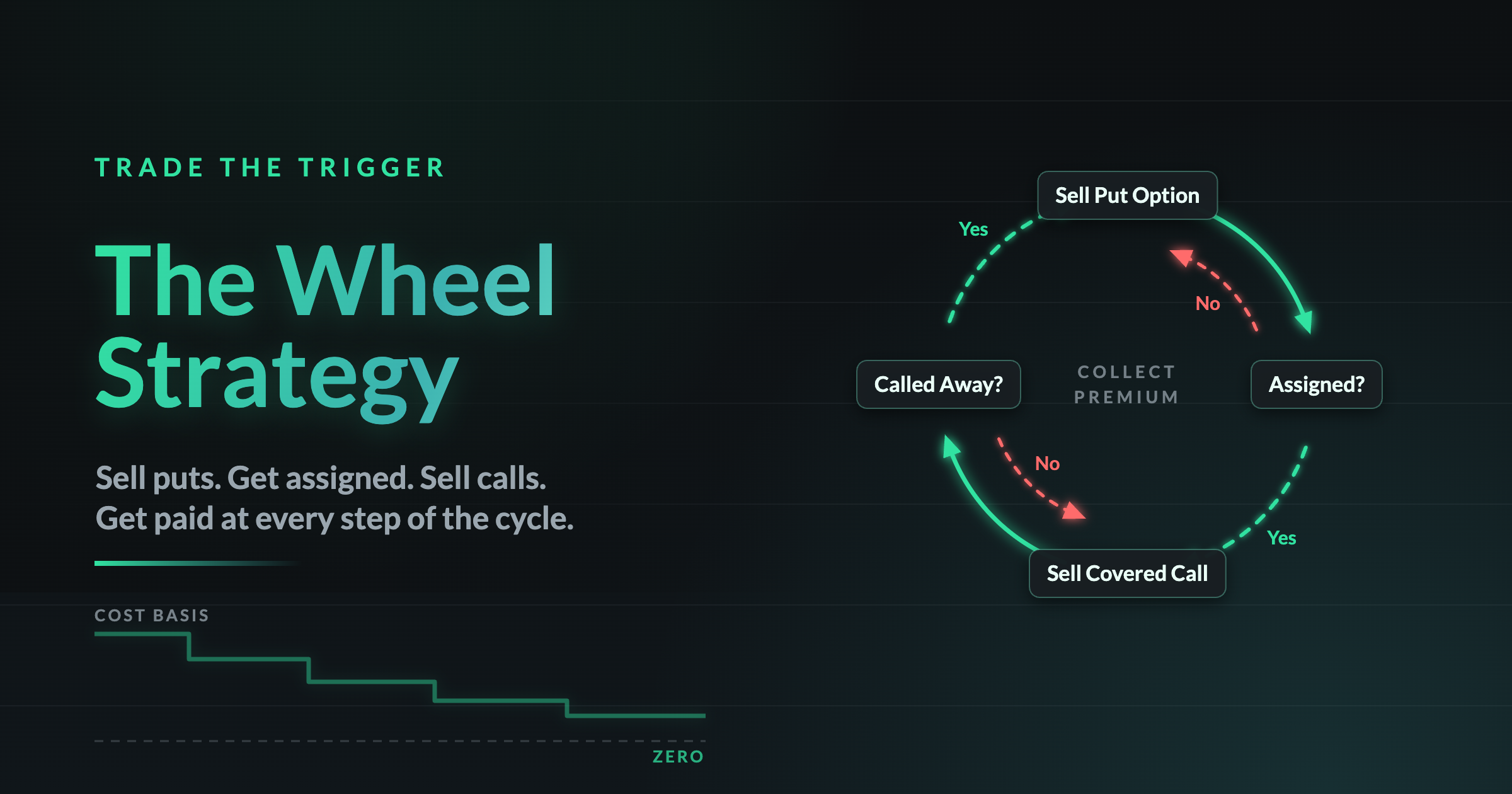
The options wheel strategy is two trades run in a loop. You sell a cash-secured put on a stock you would be happy to own. If the put expires out of the money, you keep the premium and sell another one. If it expires in the money you get assigned, you buy the shares at your strike, and you start selling covered calls against them. Every leg collects premium, and every premium you keep lowers what those shares effectively cost you.
Below is the full cycle with real numbers, the math on how a cost basis grinds down, and an honest look at what breaks. Then the four TTT tools that model each leg before you risk anything. All four come with any paid membership, and the breakdown is in who gets what.
Two legs, one loop
How the options wheel strategy works
Both legs are short premium, and both are backed by something: cash secures the put, shares cover the call. Neither carries the open-ended risk of a naked option. The downside on each is still substantial.
- Cash-secured put. Sell an out-of-the-money put and hold enough cash to buy 100 shares at the strike. Best in a neutral to bullish market. You keep the premium if it finishes above your strike, and you buy the shares at your strike if it finishes below.
- Covered call. Once you are assigned the shares, sell an out-of-the-money call against them. Best in a neutral to moderately bullish market. You keep the premium if it finishes below your strike, and you sell the shares at your strike if it finishes above.
- Then repeat. When the shares get called away you are back in cash, and the next put starts the loop again.
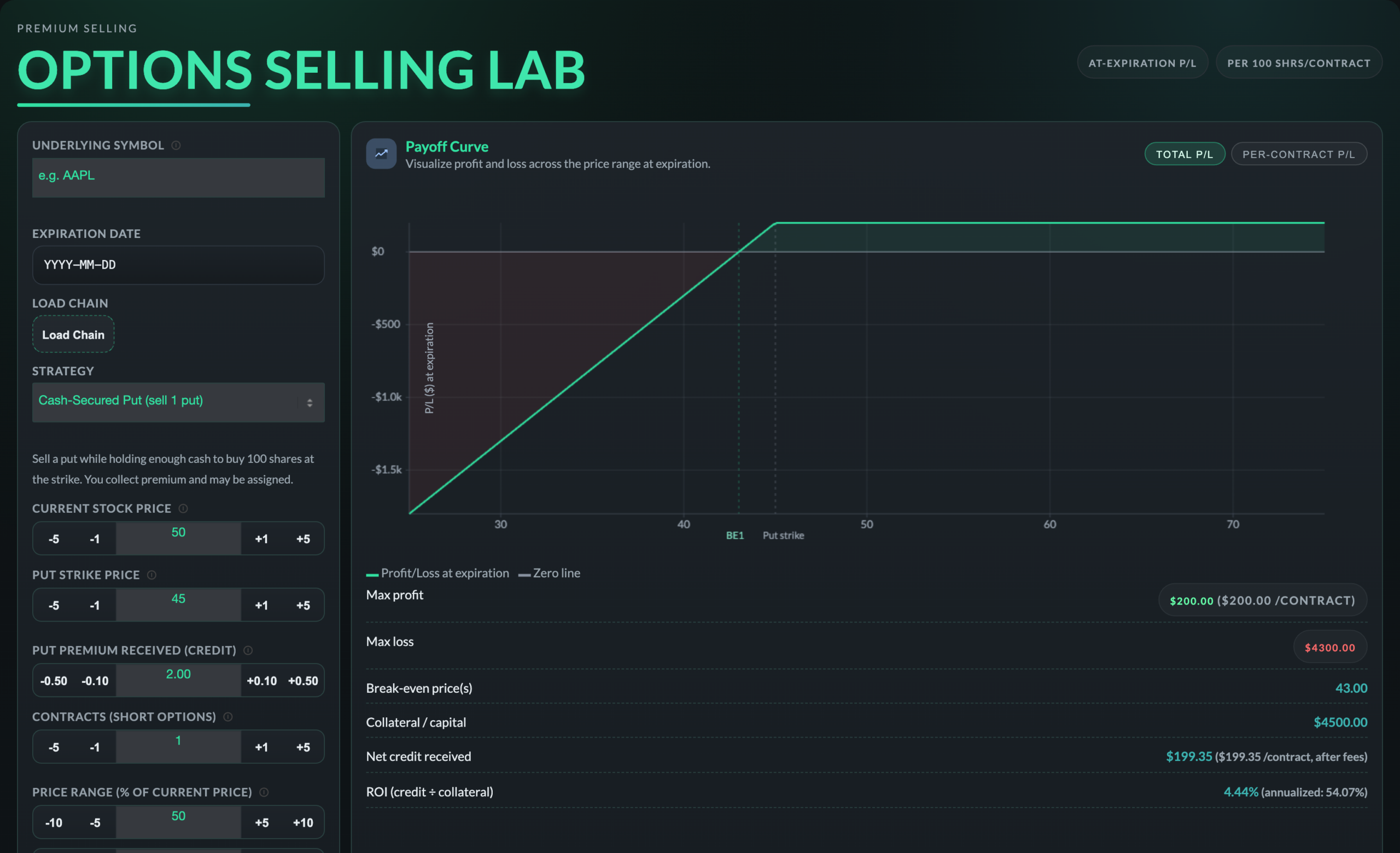
The put leg, priced out. A $45 put on a $50 stock for $2.00. The Selling Lab reads it back as $200 max profit, $4,500 of collateral, a $43.00 break-even, and 4.44% return on capital for the cycle. Its own description of the trade: “Sell a put while holding enough cash to buy 100 shares at the strike. You collect premium and may be assigned.”
One turn of the wheel
The full cycle, start to finish
Worked example
Numbers from the Selling Lab, one contract, 30 days out. The big figures are before fees. The net credit line is the one with the $0.65 per contract taken out, which is why it reads $199.35 instead of $200.
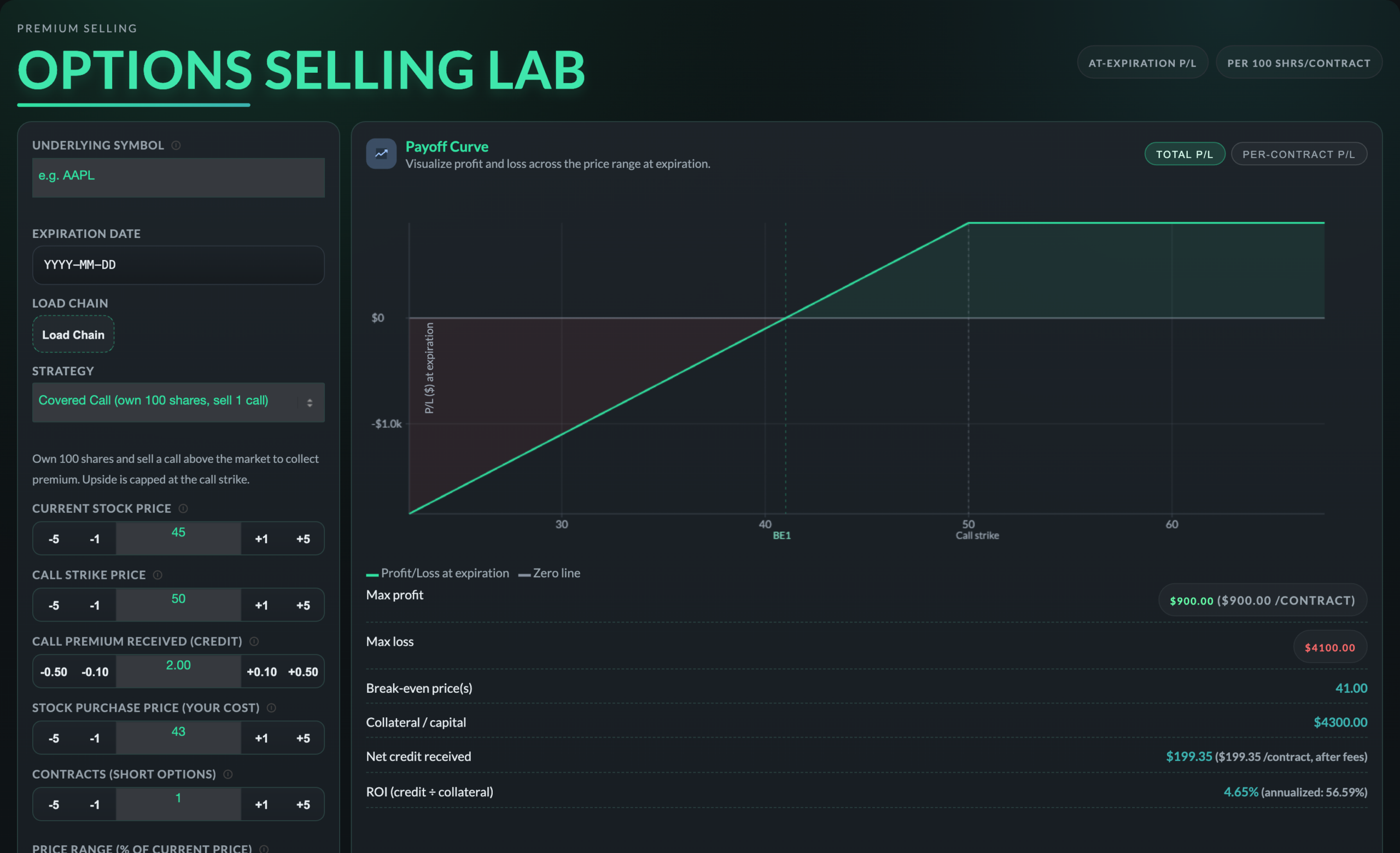
The call leg, with the basis carried forward. Stock purchase price is set to $43, which is the $45 assignment price less the $2.00 put premium already collected. The break-even reads $41.00 and the payoff flattens hard at the $50 call strike. That flat line is the cost of the trade: your upside stops there.
Why traders run it
Every premium you collect lowers your cost basis
This is the part that makes the options wheel strategy compound. You started with a stock at $50. The put premium took your basis to $43. The call premium took it to $41. Run the loop again next month and it steps down again. Dividends add to the pile too, and they arrive whether or not the options cooperate. Treat this as a running tally of cash recovered against the position, which is a different number from your cost basis on a tax form.
Traders who stay in one name for years talk about the basis eventually reaching zero. At that point the premium and the dividends have paid for the shares outright. A company that keeps raising its payout gets you there faster, since each raise is more cash arriving against a tally that is already shrinking.
A stock split is worth being precise about, because it gets credited with more than it does. A split divides the same position into more, cheaper shares. Total basis, total dividend and total value are all unchanged, so on its own it does not speed anything up. What it does change is granularity: a lower share price means less collateral per contract, so you can wheel the name in smaller increments and scale in and out more finely.
Be straight about what a zero tally is. It is a record of cash recovered. It is not a hedge. The shares are still worth whatever the market says they are worth tomorrow, and they can still fall a long way. Getting there takes years of a stock cooperating, and a single call that gets away ends the compounding in that name. It explains why the wheel appeals to long-horizon holders. It does not make the position safe.
- Put premium. Lowers the price you effectively paid on assignment. Only premium you actually keep counts, so an option you buy back for more than you sold it works against you.
- Call premium. Lowers it again for every cycle you hold the shares, net of any buybacks.
- Dividends. Pay you for holding, independent of what the options do.
- Time. The only input you cannot rush. This is a multi-year idea, not a multi-week one.
- Tax, tracked separately. Option premium is not taxed when it lands. It is recognised when the option expires, gets bought back, or is exercised. Ordinary dividends are taxable income and do not reduce your tax basis. Your cash-recovery tally and your tax cost basis are two different numbers, so keep both.
Monitoring
Managing it when price moves against you
The wheel is not a set-and-forget trade. Both legs need watching, and the fix is usually a roll: buy back the short option and sell another one further out in time, at a strike that suits the new situation.
- Put running deep in the money. Roll down and out to a later expiration and a lower strike. That usually brings in a credit, though buying back a deep in-the-money put can cost more than the new one pays, which makes it a debit roll. Rolling also replaces assignment risk rather than removing it, since the new option is assignable too. The other option is to simply take the shares, which is the whole point if you picked a name you wanted.
- Call running deep in the money. Roll up and out. Watch one thing carefully: a strike below your adjusted basis caps your sale price under what the shares cost you, so if you get assigned there you take a loss on the stock and need the accumulated premium to cover it.
- Before you sell either leg. Check that the underlying is unlikely to fall far below your put strike, and that your call strike sits at or above the price you would be happy to sell at.
- Strike selection. Closer to the money pays more premium and gets assigned more often. Further out pays less and leaves more room. That trade-off is the whole decision.
The honest part
Where the options wheel strategy goes wrong
Selling premium feels like free money right up until it does not. These are the six failure modes worth knowing before you sell the first put.
- It eats capital. Collateral is the strike times 100, so a $45 strike ties up $4,500 and a $300 strike ties up $30,000, per contract. The strategy is gated by account size long before it is gated by skill.
- Assignment is not scheduled. American-style equity options can be assigned on any business day, not just at expiration. A short call sitting in the money just before an ex-dividend date is a prime candidate, and getting assigned there costs you the shares and the dividend together. Price pinned right at your strike into expiration is its own headache, because you may not know until the weekend whether you still own stock on Monday.
- Your upside is capped. The covered call sells your gains above the strike. If the stock gaps 40% past it on earnings, you get the premium and the strike, and you watch the rest go.
- Assignment is real ownership. Being assigned does not soften the fall. Below your break-even you are long a stock that is dropping, and the premium you collected is a rounding error against it.
- The wrong name ruins it. Wheeling a company in structural decline means grinding out small premiums against a much larger capital loss. The strategy does not fix the stock you picked.
- Opportunity cost. Collateral parked behind a put is capital doing one job. In a market that runs hard, simply owning the shares would have paid more. Thin options chains add to the bill, since every roll and early close pays the spread.
The toolkit All paid members
Four tools for running the wheel
Every number in this post came out of the TTT tools. They are built for exactly the work the options wheel strategy asks of you: pricing a short premium trade, checking the return on the capital it ties up, and practicing the mechanics before real money is involved.
Options Selling Lab
The two screenshots above are both from the Options Selling Lab. Cash-secured puts and covered calls are two of its six built-in strategies, alongside short strangles, credit spreads and iron condors. It is the fastest way to answer the question that matters on every leg: what does this pay, and what is it risking to pay it. Premium collected, break-even, collateral, and return on capital both raw and annualized.
Options Profit Calculator
Use the Options Profit Calculator when you want to compare structures rather than price one. Covered Call and Cash Secured Put sit next to each other as one-click templates under Income / Credit, so you can flip between the two legs of the wheel and see how the payoff shape changes.
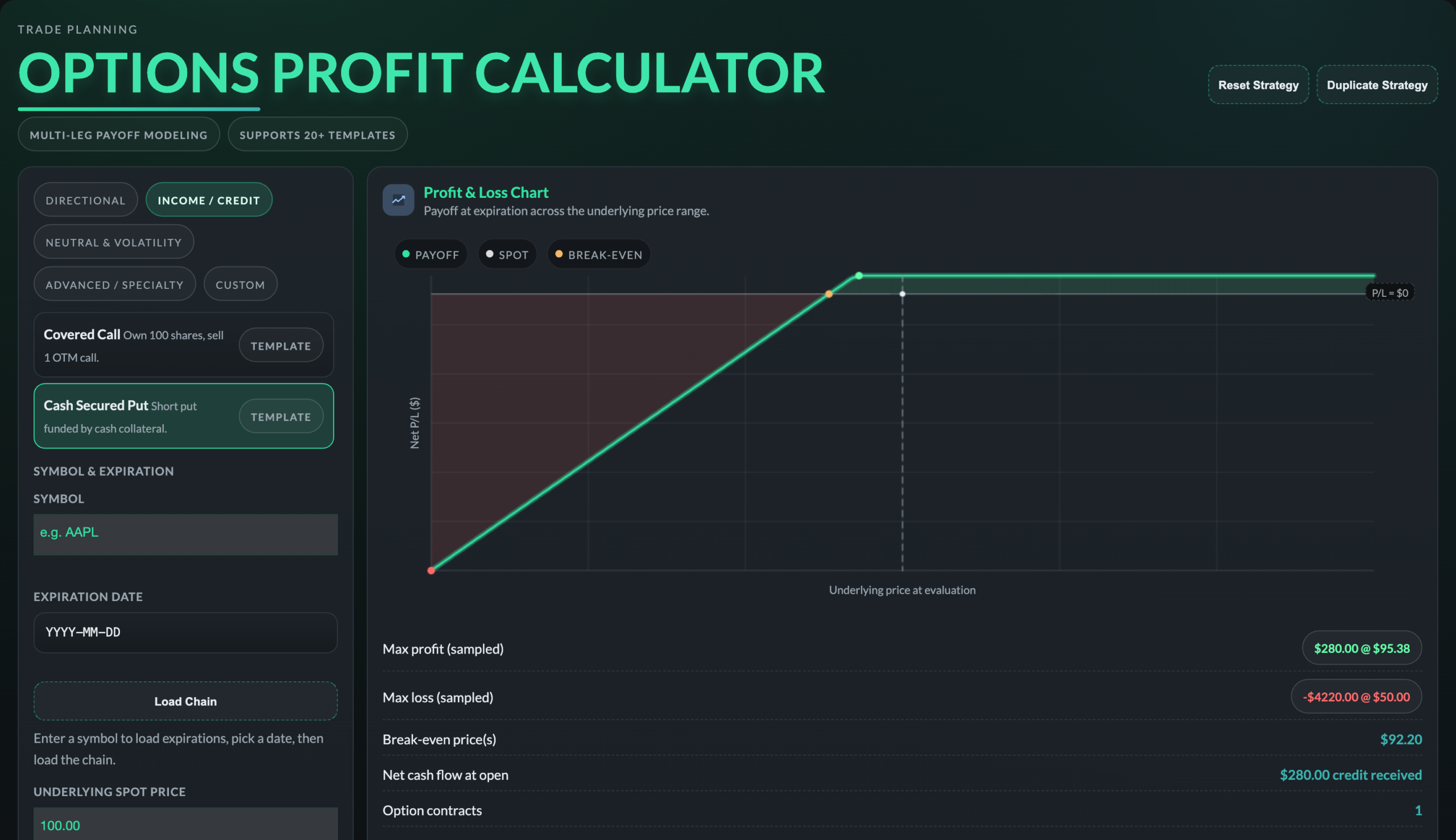
Both wheel legs, one click each. The Income / Credit tab carries Covered Call (“Own 100 shares, sell 1 OTM call”) and Cash Secured Put (“Short put funded by cash collateral”) as templates. Load one, then read max profit, max loss, break-even and net cash flow at open off the same panel.
Paper Trader
Assignment is the step that surprises people. The Paper Trader lets you run a full turn of the wheel on live chain data with no capital at risk, so the first time you get assigned is not also the first time you have seen it happen. Load a chain, route a contract into the ticket, submit, then watch it in open positions and the equity curve.
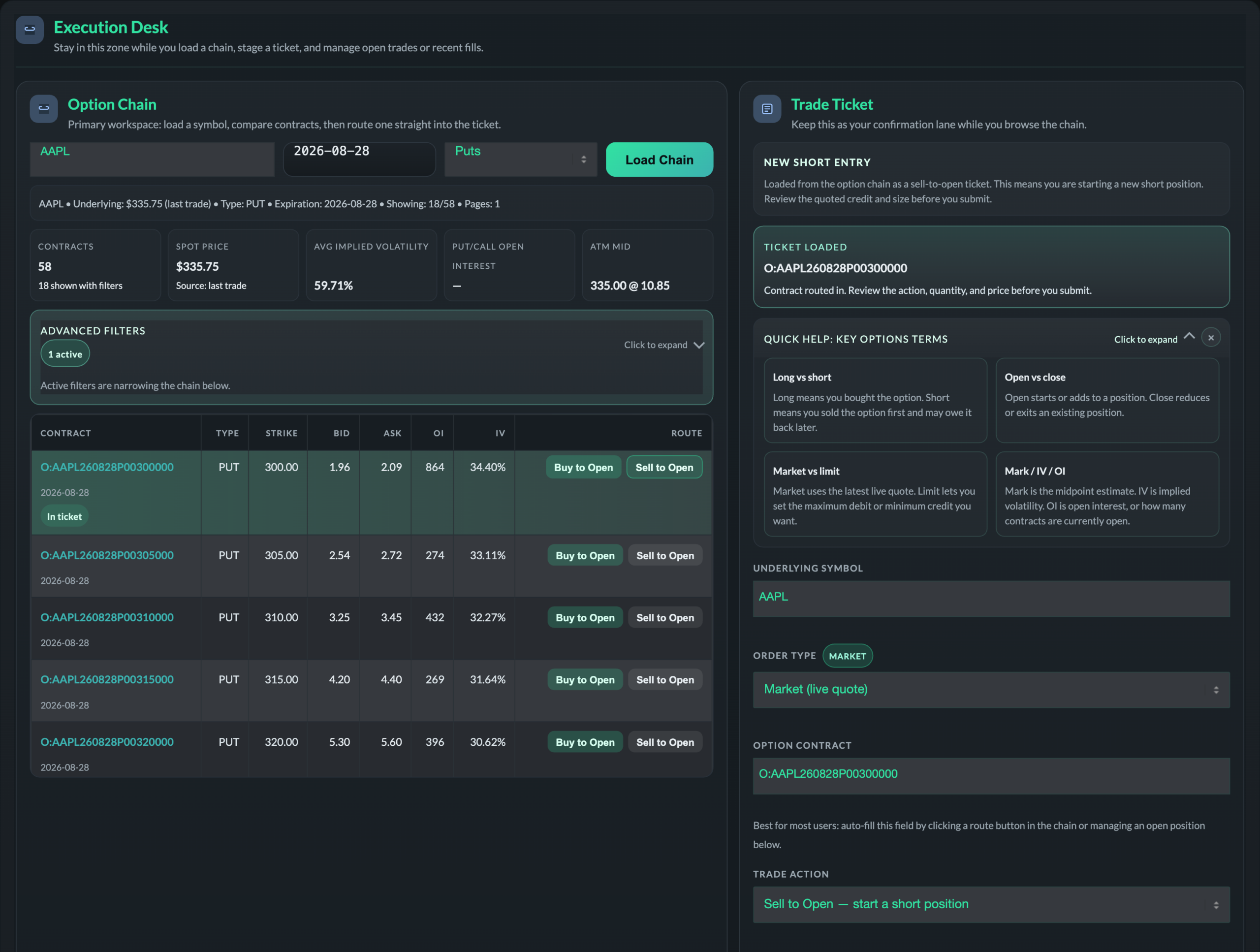
A put leg staged, not submitted. Live AAPL puts with bid, ask, open interest and implied volatility on every strike. Clicking Sell to Open routes the contract straight into the ticket, which flags it as a NEW SHORT ENTRY and spells out what that means: “This means you are starting a new short position. Review the quoted credit and size before you submit.”
GEX Visualizer
Strike selection is the part of the wheel most people guess at. The GEX Visualizer gives you the options market’s own positioning as context: where dealer gamma is concentrated, where the zero-gamma flip level sits, and which strikes carry the largest positive and negative exposure. Useful when you are deciding how far out of the money to sell.
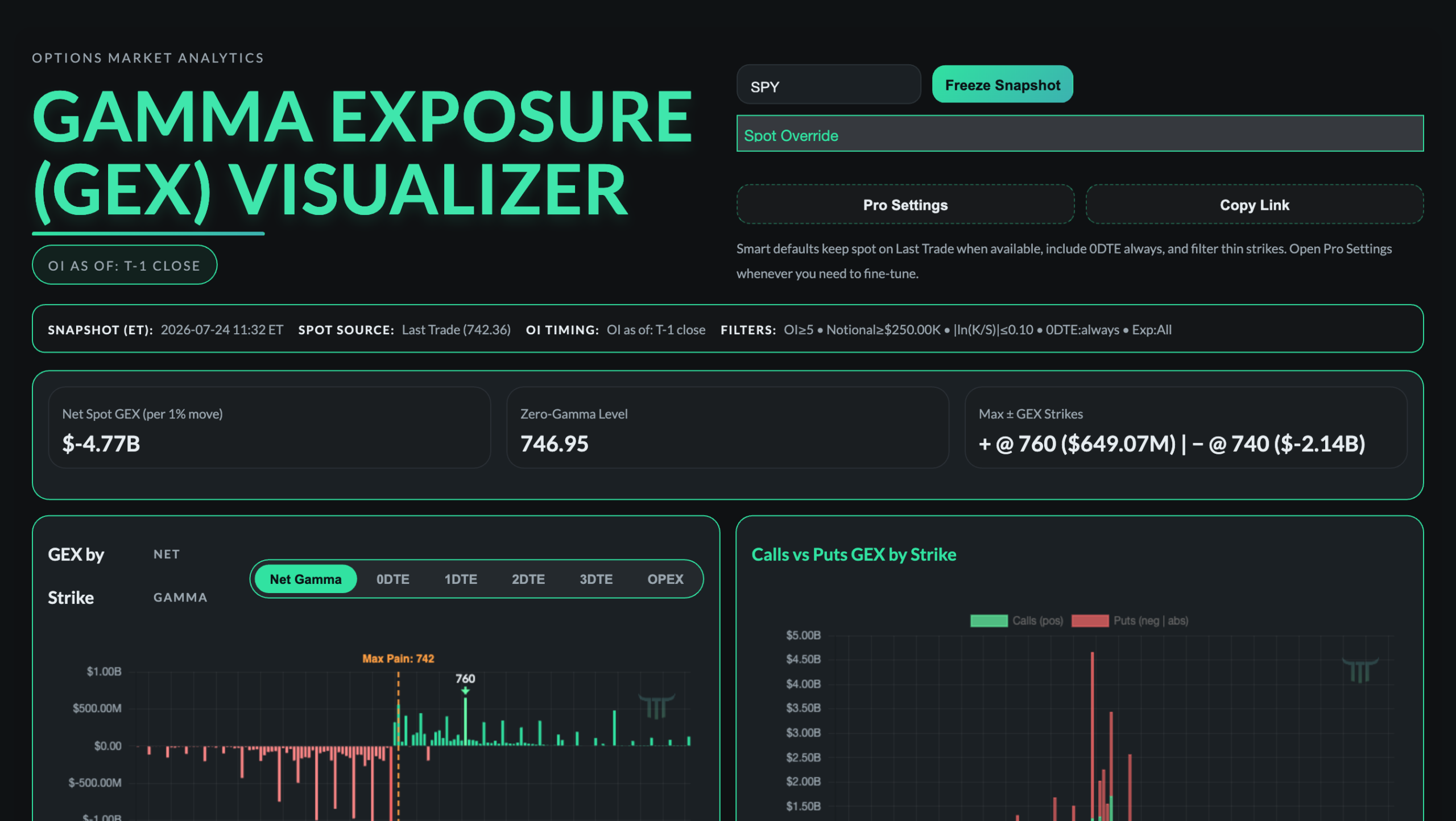
Context for where to sell. Net spot GEX, the zero-gamma level, and the largest positive and negative gamma strikes, plus a full breakdown of gamma by strike and calls versus puts. Enter any ticker and freeze a snapshot.
Who gets what
Which membership unlocks the tools
The article you just read is free and always will be. The four tools in it are for members, and any paid membership opens all four. Yearly billing gets you one month free on either tier.
- Options Selling Lab, Options Profit Calculator, Paper Trader and GEX Visualizer
- T3 Daily Pivots for TradingView, all symbols
- T3 educational videos and market updates
- Basic Discord access
- Tradytics and Unusual Whales premium bots
- Daily Trigger and Velocity snapshot charts
- Full T3 Indicator Suite
- Premium Discord with the T3 team
- Everything in Subscriber, including all four options tools
- Full T3 Indicator Suite for TradingView: Triggers, Velocity and Pivots
- Premium Discord with direct access to the T3 team
- Pro Updates
Four steps
Get started
Model your next wheel before you sell it
One membership opens the Selling Lab, the Profit Calculator, the Paper Trader and the GEX Visualizer. Start at Subscriber for all four, or go Pro Trader for the full indicator suite and the premium Discord.
Educational content only. Nothing here is financial advice. Every figure in this post is a worked example from the TTT tools, not a recommendation or a forecast. Options carry real risk, the wheel ties up significant capital, and assignment means owning a stock that can keep falling. Do your own DD and trade your own plan.